
RxSTAR ILMARINEN
About the Project
RxSTAR ILMARINEN is an amateur radio telescope system designed and built for independent radio astronomical research. The system is optimized for observation in the L-band, with a primary focus on detection of the galactic neutral hydrogen line at 1420.405 MHz (the HI line), solar radio bursts, and broadband continuum surveys of celestial radio sources.
The project takes its name from Ilmarinen, the eternal blacksmith of Finnish mythology, a tribute to the craftsmanship inherent in building a precision radio receiver from consumer hardware. Every component, from the antenna geometry to the low-noise amplifier chain, has been carefully selected and calibrated.
Design Philosophy
The core design goal was to achieve the maximum scientific utility within the constraints of a low-budget, portable, and independently operated system. Off-the-shelf SDR hardware is combined with custom feed design, digital signal processing pipelines, and automated data logging to produce a system capable of reproducible scientific observations.
System Specifications
| System type | Horn + SDR |
| Primary reflector | NA m diameter |
| Feed type | Horn |
| LNA noise figure | 1.5 dB |
| Receiver bandwidth | 2.0 MHz |
| Center frequency | 1420.405 MHz |
| ADC resolution | 14-bit |
| SDR backend | SDRPlay RSP1B |
| Software pipeline | Linux, Soapy, Windows |
| Mount type | AZIMUTAL |
| Data logging | csv, pdf, png |
| Location | Zaragoza, España |
Observation Objectives
The ILMARINEN system is oriented towards a set of well-defined amateur scientific objectives. The main activity is the analysis of the activity of the Milky Way and the study of the escape velocity of its different sections, using for this the frequency drift and the Doppler formula.
- OBJ-01 Detection and spectral mapping of the galactic 21 cm HI emission line across multiple galactic longitudes.
- OBJ-02 Monitoring of solar radio flux in the 30 MHz band with the input LNA stage removed (Filtering for H1) during active periods and reference measurements of the quiet Sun.
- OBJ-03 Detection of strong continuous SETI radio sources.
- OBJ-04 Total power drift-scan surveys of the galactic plane to produce longitudinal brightness temperature profiles.
- OBJ-05 But mainly HAVE FUN!!!
Signal Processing Pipeline
Raw I/Q samples from the SDR are processed in real time using a custom software pipeline. A multi-stage polyphase filter bank divides the band into narrow spectral channels, enabling simultaneous total power and spectral analysis. RFI mitigation algorithms flag and excise terrestrial interference before integration. Calibrated output data is written in FITS and CSV formats for archival and analysis.
├─ receiver : ONLINE
├─ freq_center : 1420.405 MHz
├─ bandwidth : 2.0 MHz
├─ integration : up to 1000 s
├─ T_sys : NA K
└─ log_target : Milky Way
rxstar@ilmarinen:~$ _
Documentation & Observations
Visual documentation of the RxSTAR ILMARINEN system: hardware construction, installation, calibration procedures, and sample observation outputs.
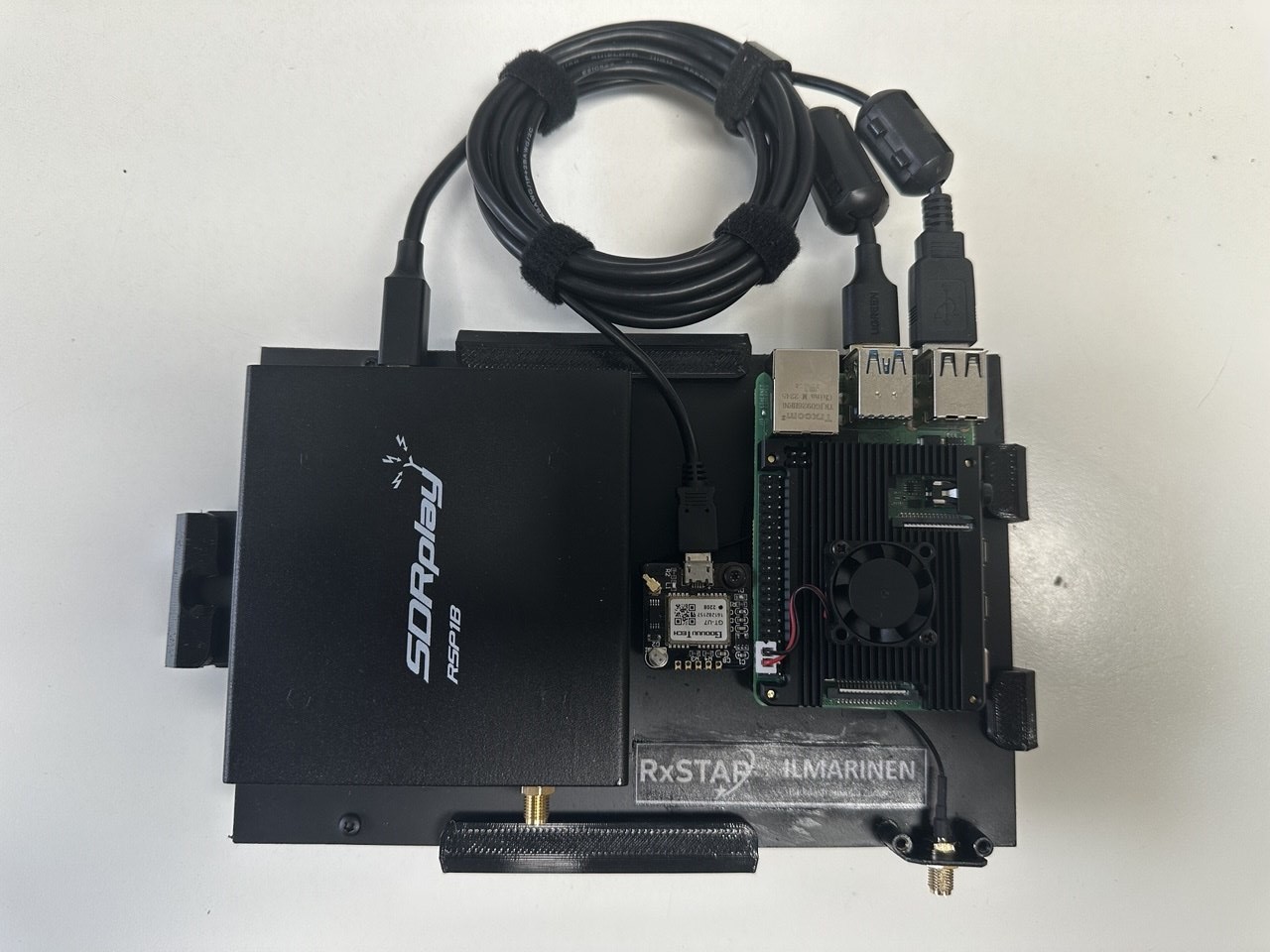
Main System. Radio Equipment and Command Interpreter. SDR 14-bit SDRPlay, Raspberry Pi 4 and U-blox GPS with Active Nautical Antenna.
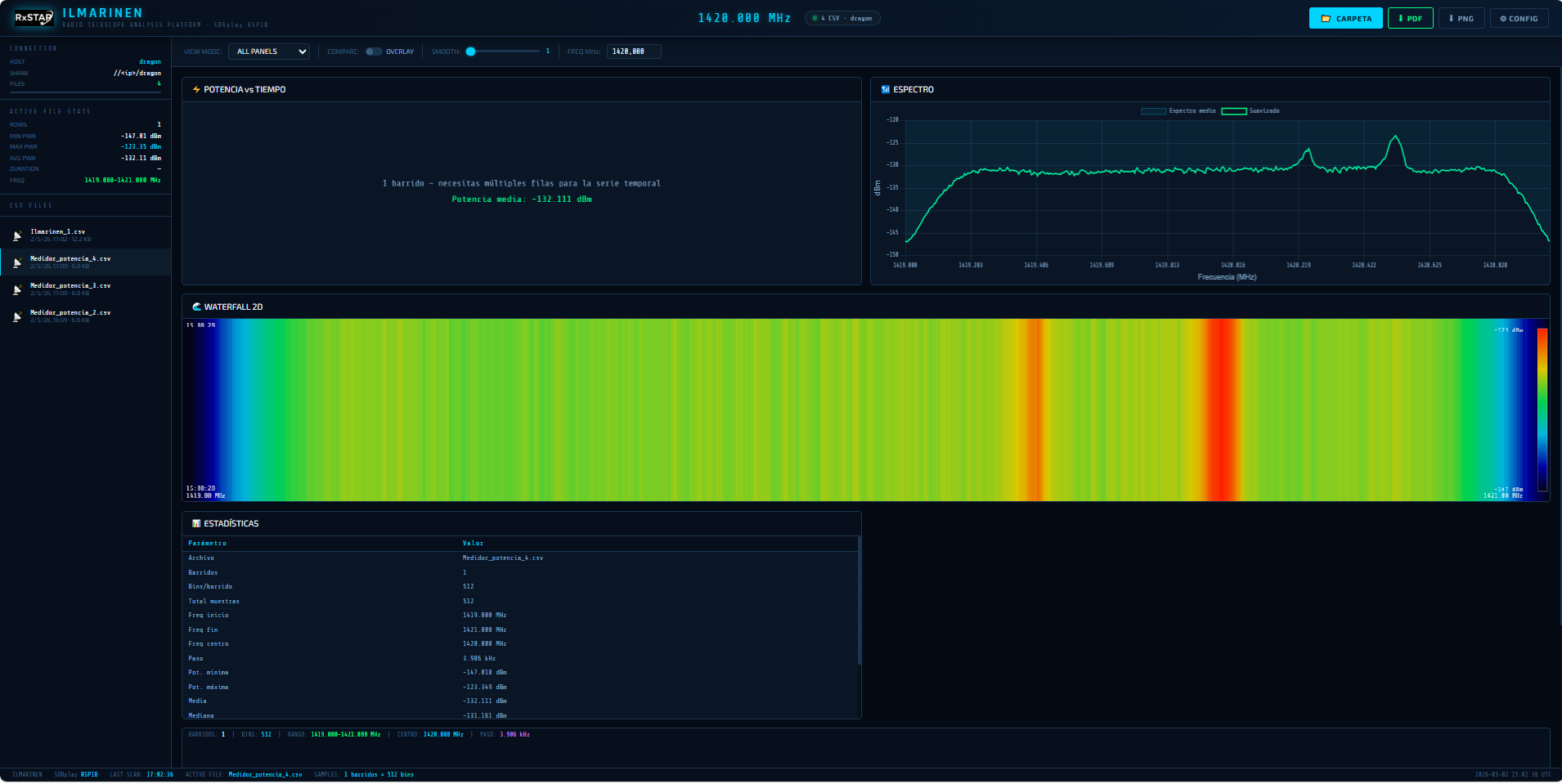
Main screen for chart visualization, report export in PDF/PNG format. SAMBA type access to the remote team's integration repository. Statistics and average, maximum, minimum values, and relevant information. Waterfall and modern and striking presentation!!!
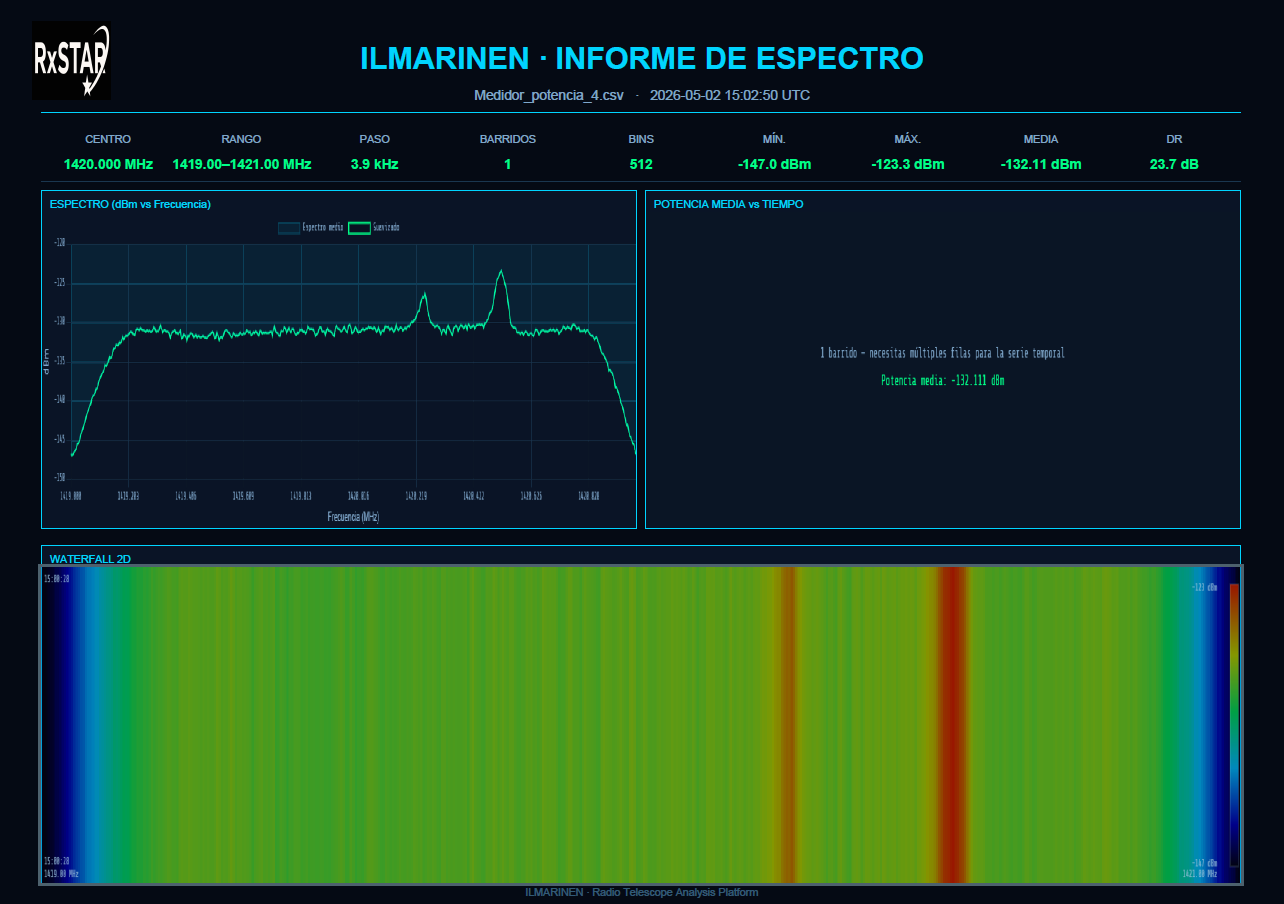
Example of report generated in Direct PDF to share or download (On the control PC).
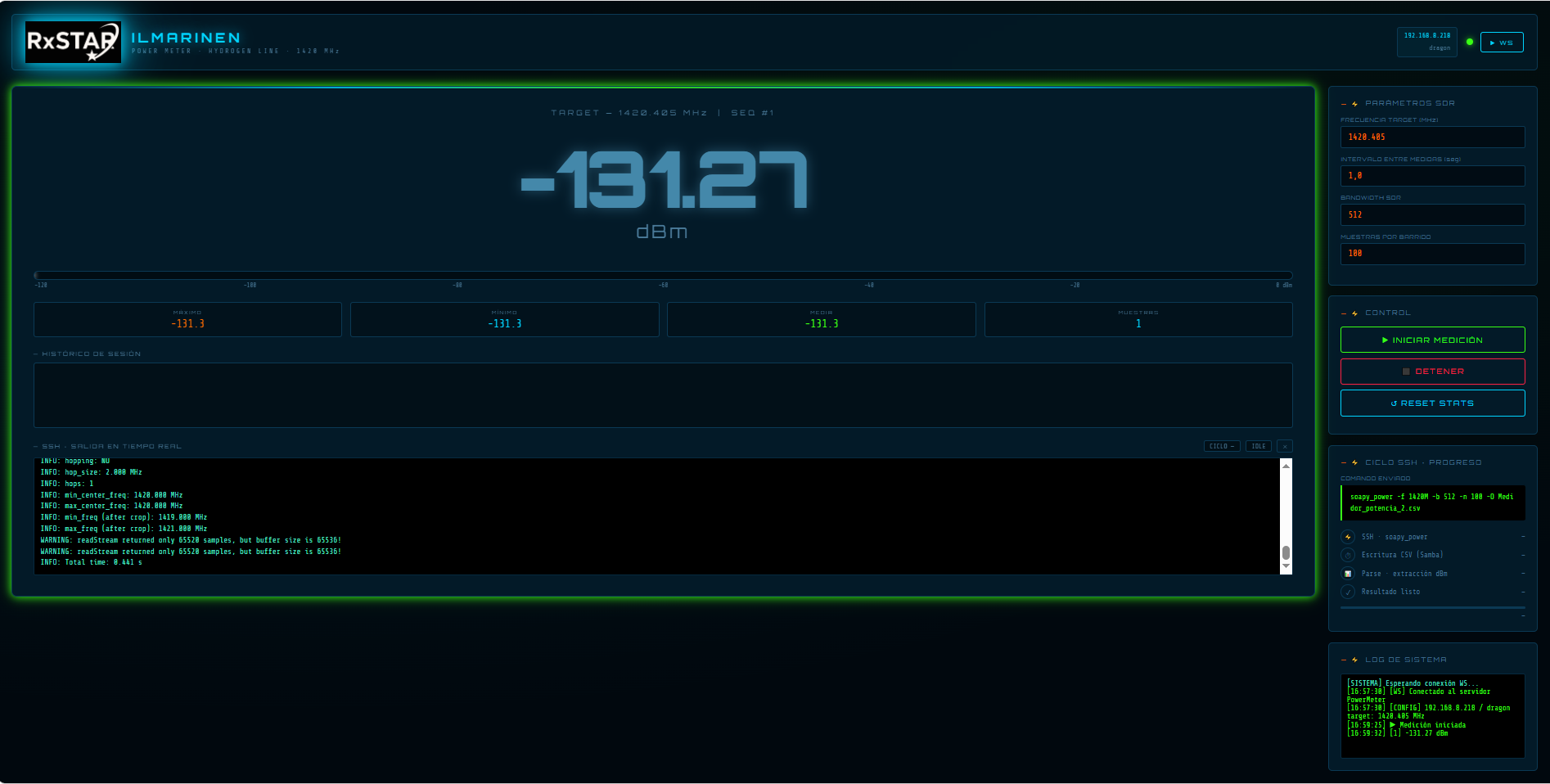
Real-time power meter. Utility intended for collimation and adjustment, if necessary, of radio systems. Useful for "eyeballing" the antenna towards the Milky Way. Automatically performs a set of special measurements with an average value of 100 for measuring the peak received at the selected central frequency.
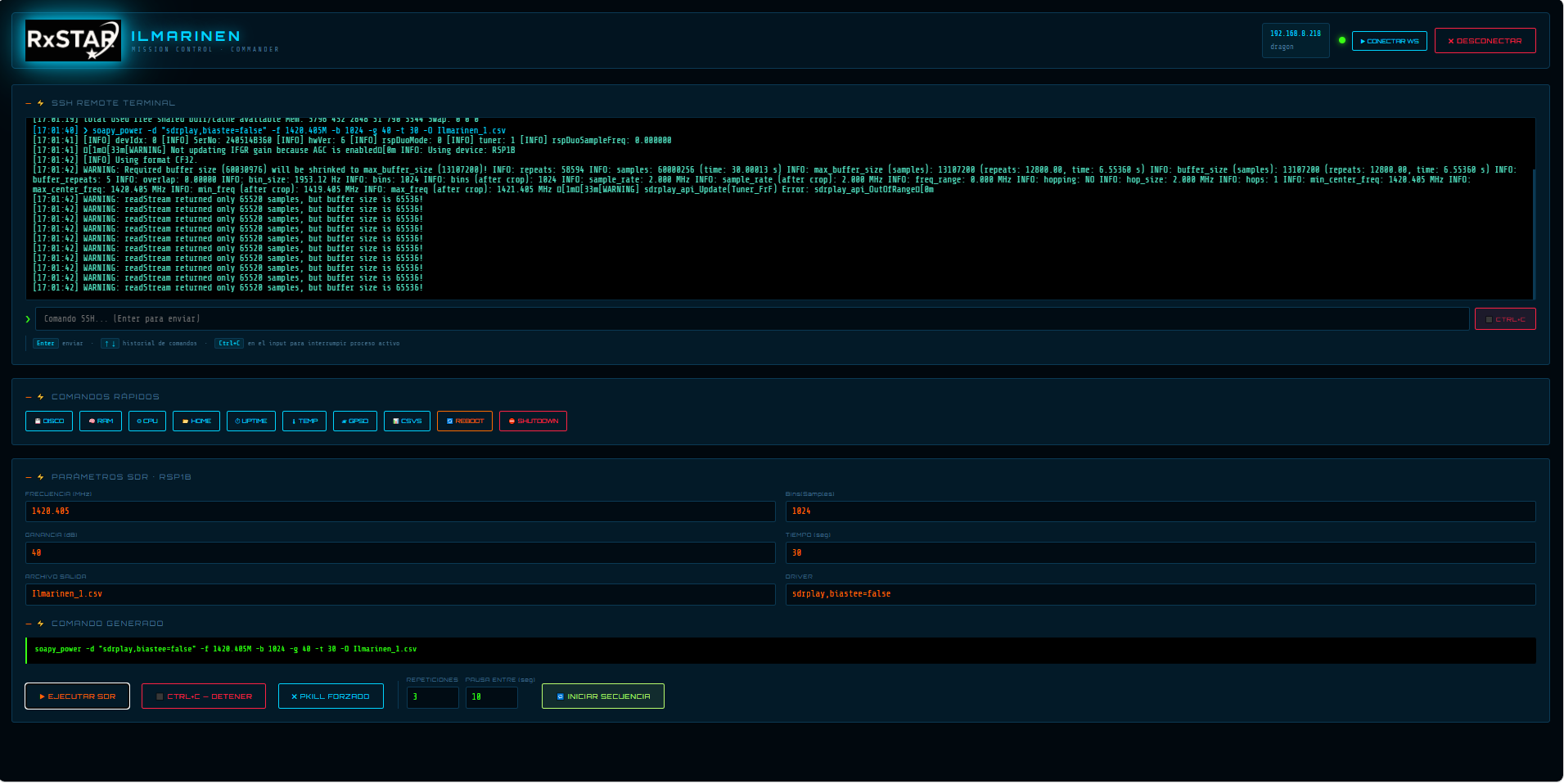
SSH console specialized in carrying out the necessary integrations. It has two working modes, individual command, configurable with the information on screen and repetition, sequence of automatic integrations with sequential log file. It has generic utilities, system SSH commands and reboot and shutdown of the equipment.
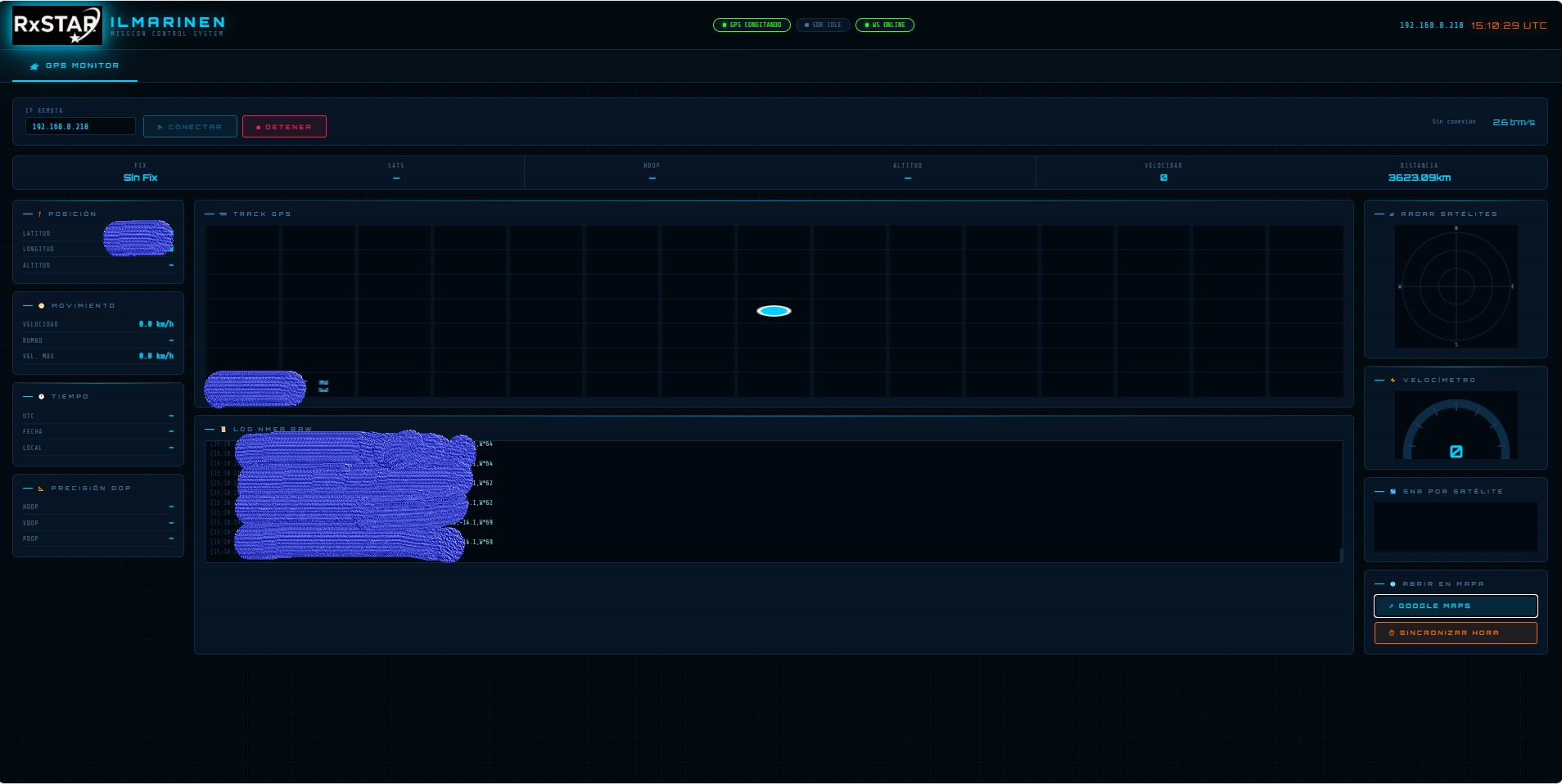
U-BLOX GPS with Active Nautical antenna and temporal correction of the system, uses the GPS to determine the exact time of the equipment with microsecond precision (NTP service also available with Internet connection).
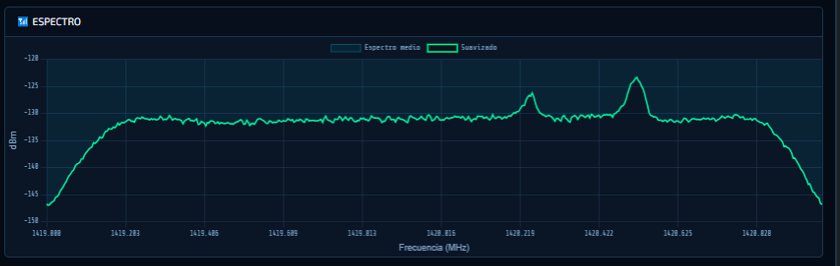
Detail of ILMARINEN FFT integration graph according to configurable parameters.
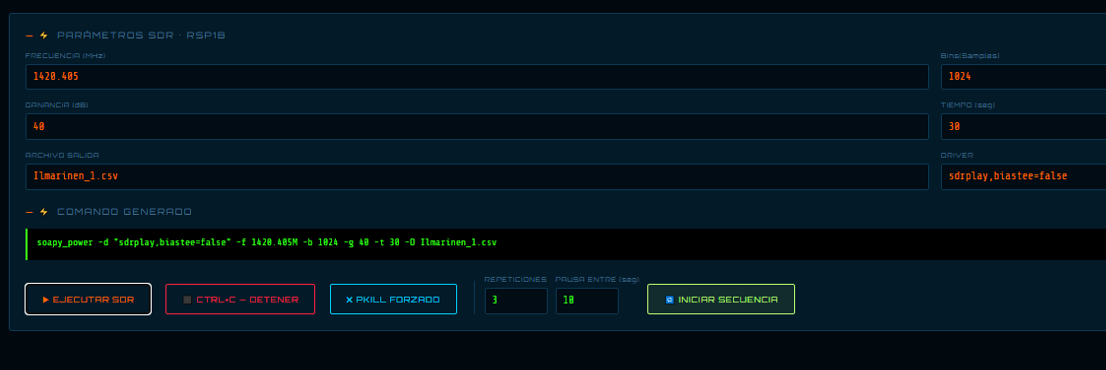
Detail of parameterizable integration generator console and automatic command sequencer.
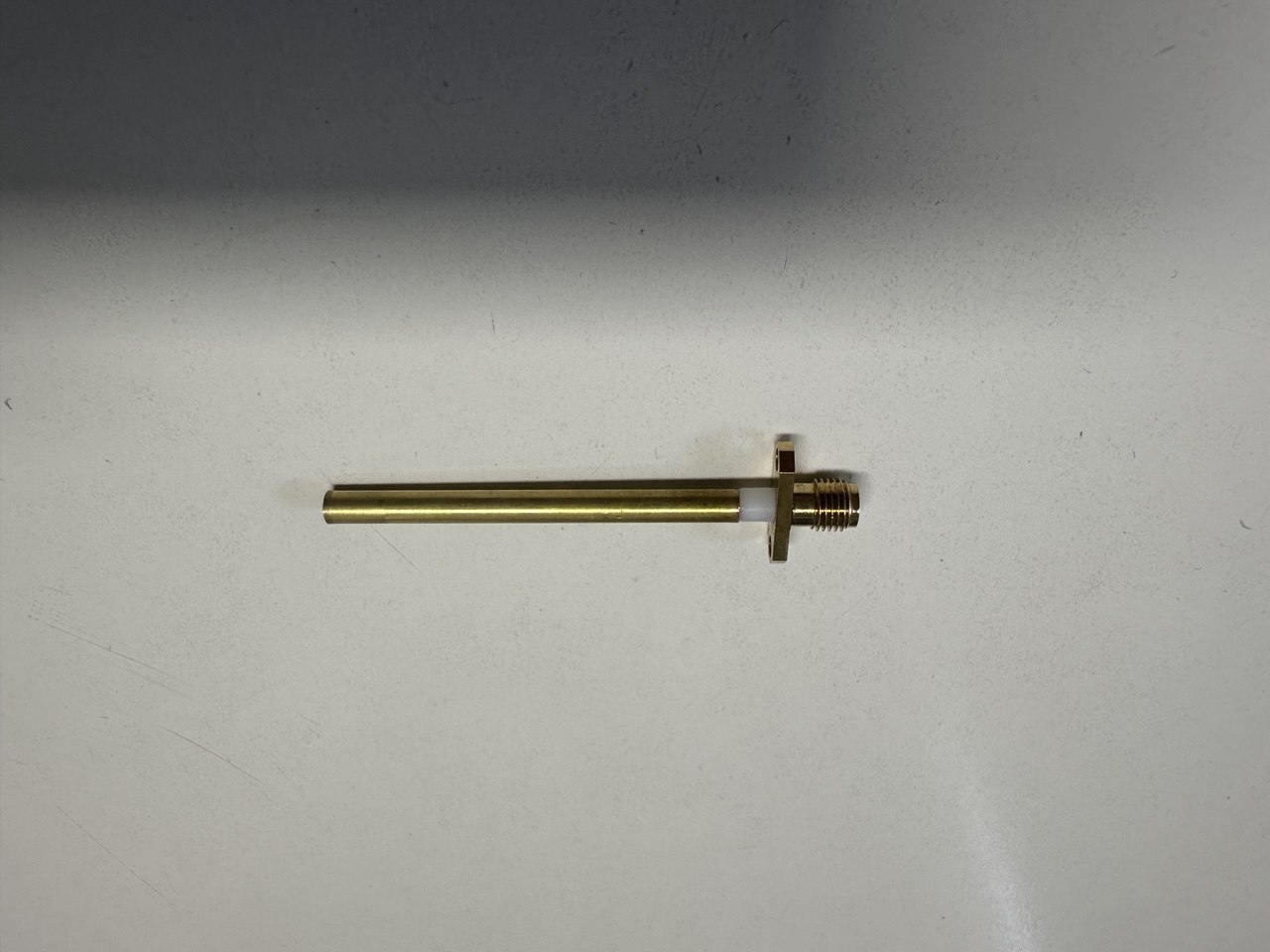
MONOPOLE specially designed for 1420.405MHz, turned in brass and with a female SMA connector of specific wall for the equipment, Teflon insulator and precision length.
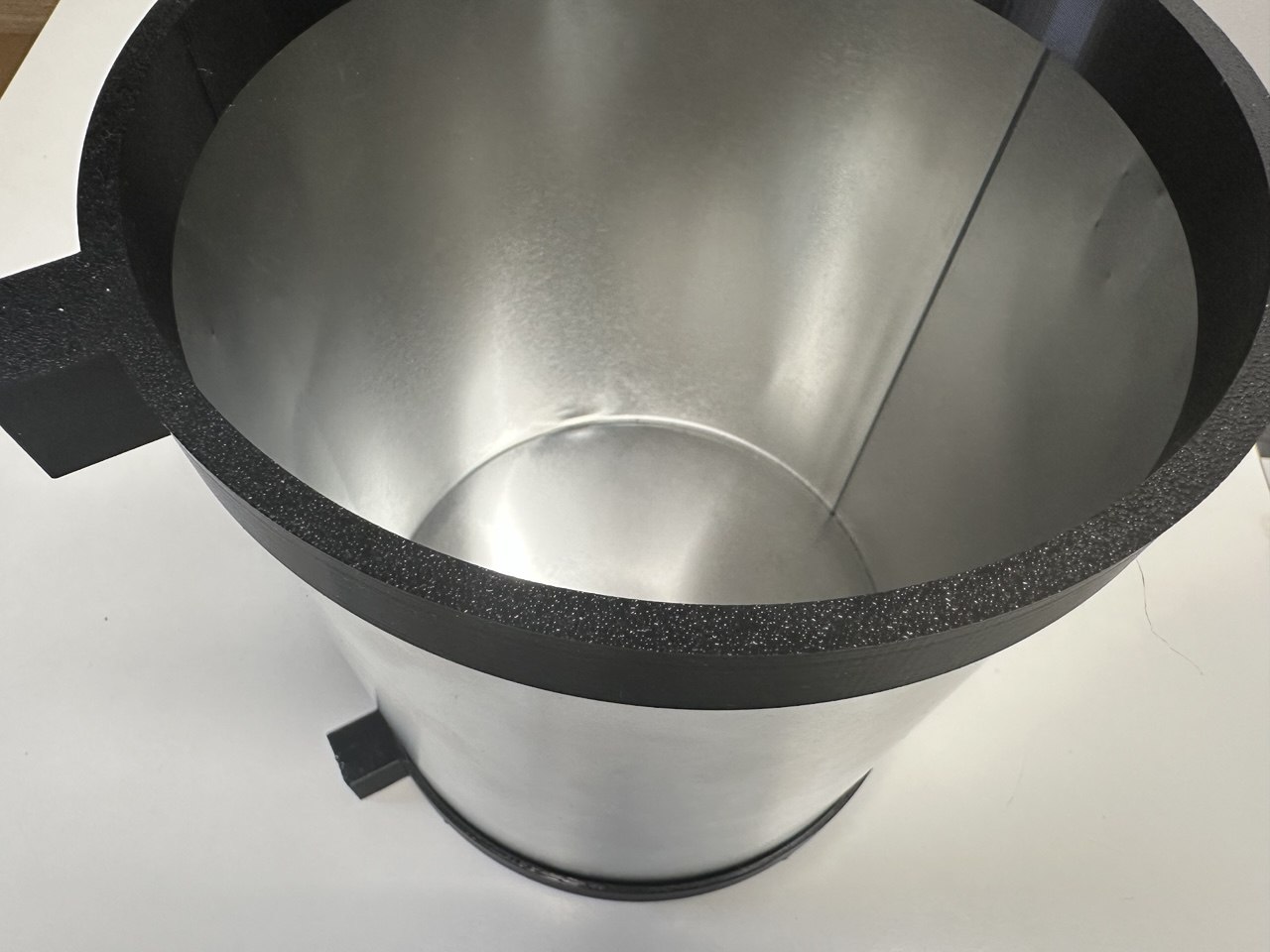
Guided-type antenna with a cutoff frequency at 919MHz and specific length for the hydrogen band. Printed PETG mounts. Can be used as a main antenna or as a feed in the focus of a parabolic. Gain of 11dB and high-quality material.
System Architecture
The ILMARINEN receiver chain follows a classic superheterodyne-inspired SDR topology. The RF signal captured by the Antenna is routed through a bandpass filter to reject strong out-of-band interference before reaching the low-noise amplifier (LNA). The amplified signal is further filtered, down-converted, and sampled by the software-defined radio frontend, which delivers calibrated I/Q baseband data to the host processing computer.
RF Chain
The receive path begins at the focal feed, which collects electromagnetic radiation from the reflector surface and couples it into a coaxial transmission line. A SAW filter centred at the target frequency precedes the LNA to reduce the receiver noise contribution from strong broadcast signals in adjacent bands. Bias-tee injection supplies DC power to the remotely-mounted LNA over the coaxial cable, minimising cable losses before amplification.
Computing & Software
The baseband I/Q samples from the SDR are transmitted to the local control via USB 3.0. The main signal acquisition and processing stack runs under Linux, using Soapy for real-time spectral analysis. Long-duration observations are managed by a custom scheduling daemon that handles file segmentation, RFI tagging, and automatic upload of reduced data products. All of this is done remotely from a PC via Wi-Fi or Ethernet (preferably).
Get in Touch
Interested in amateur radio astronomy, collaboration, data sharing, or technical questions about the ILMARINEN system? Feel free to reach out via email or connect on LinkedIn.